Monday, January 21, 2013

Review of Fall Semester -- Pigs have arrived!

In class this week, we reviewed what we learned from all the dissections of the fall semester.  Some of the concepts we had covered were: symmetry, cephalization, completeness of the digestive system, jointed appendages, and vertebrae.

  • Symmetry meant whether there was a pattern to a body in which two sides are mirror images (bilateral) or you could rotate the body and find a position that lined up (radial).  
  • Cephalization was whether there was a brain, a group of nerve cells called a ganglion, or no brain-like structure.  
  • The digestive systems were complete if the animal's food went in one end and came out the other, and incomplete if the waste came out the same opening the food went in.  
  • Jointed appendages are limbs like arms or legs that have joints.  
  • Vertebrae are bones that line the nerve cord or spinal cord.
What vertebrate group did we look at that isn't on this chart?


We made a chart about the animals we dissected and these five concepts:


It was really neat to see how much we've learned, and how many animals we've already studied!  We also reviewed the five kingdoms: Monera (bacteria), Fungi, Plantae (plants), Protista, and Animalia (animals).  The kingdoms are subcategorized into phyla (singular is phylum).  Here is the phylum for each animal we studied in the fall: 
  • sponge: Porifera
  • hydra: Cnidaria
  • planaria: Platyhelminthes
  • mussel: Mollusca
  • earthworm: Annelida
  • crayfish: Arthropoda -- class is Crustacea
  • grasshopper: Arthropod -- class is Hexapoda (insects)
  • sea star: Echinodermata
  • amphioxus: Chordata, though we discussed that Hemi-chordata would make more sense
  • perch: Chordata
  • frog: Chordata -- class is Amphibia
  • snake: Chordata -- class is Reptilia
  • rat: Chordata  -- class is Mammalia
The scientific naming system uses two words to describe each organism, the genus and the species.  One species of perch is Perca flavescens, one species of frog I am familiar with is Xenopus laevis, lab rats are Rattus norvegicus, my least favorite housemate is the fruit fly, Drosophila melanogaster, and we people are Homo sapiens.

Here is an example of the classification system showing how it gets more specific with each level until you only have one organism.

Now, we are going to move on to the pig dissections, which will be in in-depth look at the body systems mammals have, as well as an exploration of autopsies and forensics.  We discussed that autopsies have one of two purposes: both are to find out why someone died, but clinical is for medical reasons -- like whether it was a heart attack, seizure, or aneurysm -- and forensic is to gather evidence about a crime -- generally the murder of the person in question.  In zoos and in laboratories, if an animal dies, a necropsy is the term for the investigation to determine why the animal died.  

We will be dissecting our pigs in the style of an autopsy, including sewing the animal up at the end, which is done in human autopsies to leave the body ready for burial.  Along the way, we will look at the following systems: muscular system, nervous system, cardiovascular/circulatory system, respiratory system, digestive and excretory system, endocrine system, and reproductive system.  We have two adult pig organs to compare with our fetal pigs: a heart and a kidney.  They are surprisingly large!


artery
I got a new dissecting scope that has a camera we can connect to the computer and project onto the big tv screen, and the kit we got included a few stained slides to look at.  So, we explored the new scope a bit and took a few interesting pictures.  These pictures are of an artery, a vein, and a hair from Henry's head.
Henry's hair
vein


Friday, January 11, 2013

Rats! And Rats Again!

The holiday break is over and we're dissecting again!  We dissected rats a second time and looked more at the muscles and bones this time.  To catch up with the blog, here's what we covered on the rats before break:

  • Rats are in the phylum Chordata and class Mammalia (both in the kingdom Animalia)
  • Mammals have hair (or fur), have mammary glands to produce milk, and bear live young
  • Looking externally, we saw that they have whiskers next to their noses, have long teeth in their mouths, have a nictitating membrane over their eyes to keep in moisture, have external ear parts called the pinna, have visible mammary glands, and all of ours were females
  • Mammalian hearts have four chambers
  • The diaphragm is a thin membrane of muscle separating the heart and lungs from the lower abdominal cavity
This week, we started by talking about research articles.  In trying to decide what article to discuss, I knew there would be quite a lot of choices, since rats are a major research animal, and many studies on them are published all the time.  So, I decided to make a list of how many articles were published in 2012 on each of several species or groups of species.  Here's what I found by searching PubMed:
Number of articles pubished or accepted for publication in 2012 on
  • Rats: 185,624
  • Mice: 205,424
  • Zebrafish: 4,510
  • Drosophila melanogaster (fruit flies): 11,949
  • Corn: 5,523
  • Bacteria (in general): 180,158
  • Viruses: 91,308
  • Human: 1,242,225
So we could see that people are very interested in researching ourselves!  I discussed two articles about rats:  one was about their whiskers, because people are interested in understanding how rats get information from their whiskers.  There is an interesting area in the brain called the barrel cortex, and it is where information from each whisker goes to a special spot.  

The other article I discussed was about stomach damage that occurs when the liver is diseased.  When someone has liver damage called cirrhosis (which can be caused by alcoholism), their stomach can be more sensitive and easily damaged.  In this research study, some rats were given liver damage and some were not.  Both groups were then tested to see how easily their stomachs were injured, and some received treatment drugs the researchers were testing.  They found that one drug, called ET-3, seemed to protect the rats from stomach injury, which helped the researchers understand more about how the stomach injury may be happening.

Next, we dissected the rats, and talked about several important things:
  • There are two main body cavities: the thoracic and the abdominal
  • In the thoracic cavity are the heart, lungs, trachea, esophagus, and ribs.
  • The trachea is the rigid tube that goes from the mouth down to the lungs.  It needs to stay open so we can breathe, and it branches into two bronchi.
  • The esophagus is the soft tube that goes from the mouth down to the stomach.
  • In the abdominal cavity are the stomach, liver, gall bladder, intestines, kidneys, bladder, pancreas, and spleen
  • The diaphragm separates the two, but also is what allows us to breathe.  When it moves down, we breathe in, and when it moves up, we breathe out.  It is also responsible for the hiccups!
  • The largest internal organ is the liver, and it has four lobes.
  • The liver produces bile, which helps digest food.  It is also why our poop is brown!  
  • The largest external organ is our skin!
  • Some muscles that rats and humans have are the biceps, triceps, deltoids, obliques, quadriceps, latissimus dorsi, and abdominals
  • Some bones we talked about were the femur, tibia, fibula, and the hip ball-and-socket joint
  • The kidneys filter our blood, and if you have no working kidneys, you have to have dialysis to clean your blood.  But one working kidney is enough, so you can donate one to someone else to save their life!

Monday, December 10, 2012

Snakes! A little creepy, but very cool!

Wow!  We dissected snakes!  Most were pretty long, around 2-3.5 feet or so.  There was one that was very small, and my guess was that we ordered so many they didn't have enough large ones so they took a younger, smaller one.  We were disappointed about not being able to see any animals inside the stomachs of our snakes.  I guess they didn't feed them before sacrificing them.  But we did learn a lot!

The snake is in class Reptilia, which is a group of animals well adapted to live on land.  We noticed the differences between the scales on the bottom of the snake compared to those on top, and saw that the eyes are covered with scale, not a thin membrane like the frog's eyes.  We thought it was cool that each scute, which is a scale on the ventral side of the snake, corresponds to a rib in the snake!

It took us a while to find the tongue of the snake, it is tiny and black and forked.  It is a sense organ for smell, and it tastes things in the air, then puts them on the roof of its mouth where Jacobson's organ sends information about the molecules to the brain.  The snake does not have ears, but detects vibrations in the ground through ossicles, which are ear bones.

Snakes have two nares (basically like nostrils) on their snouts, and two inside their mouth, and that's how they breathe.  It turns out they generally have one big long lung going along their bodies, and also a second very small one that doesn't function.  Of course all the organs of the snake need to be long and thin to fit in their bodies, so the hear, liver, and kidneys are also like that.  There is a lot of fatty tissue in the snake, we figured to keep their bodies warm when it gets cold.

Like the frog, the snake's heart has three chambers and the blood mixes in the ventricle.  This is different from how our heart works.  We'll see with the next dissection how a mammalian heart is organized.

Research article:  This week's research article was about how snake venom does what it does.  We discussed that snake venom is not a poison because eating it is not dangerous.  But when it gets in an animal's bloodstream, it does several things.  For one thing, it has specific proteins in the venom that prevent the blood from clotting, so that the other proteins in the venom can attack the entire animal.    The other proteins often do things like block the signal from the nerves to the muscles, but they can also attack and kill red blood cells.  The article I discussed was "The collagen-binding integrin a2b1 is a novel interaction partner of the T. flavoviridis venom protein flavocetin-A".  They found that a specific venom protein called flavocetin-A sticks very tightly to a protein called integrin a2b1 as a way of blocking blood clotting, and this could be a helpful piece of information for developing new drug treatments for medical purposes.

Review from last week:  We didn't have time to discuss frog research last week, so I shared this article about tadpoles and how they respond to parasites and predators.  I also mentioned this article which explored how tadpoles start to get bulgy and fat after coming in contact with predatory salamanders.  Weird!  This image shows a regular tadpole on the left, and the bulgy morph on the right.

Monday, December 3, 2012

Interesting things about the bullfrog


Frogs -- Classic animal, but we were surprised

We finally got to dissect frogs, the stereotype of all dissections.  I had never dissected one before though!

Q & A about frogs:

1.  What is the significance of frogs (why were they a part of the evolutionary diversity animal dissection kit)?  They represent the transition from an aquatic lifestyle to a terrestrial one -- the shift from water life forms to life on land.

2.  What is a tetrapod?  An animal with four limbs, typically two forelimbs with upper arms, forearms, and hands, as well as two hindlimbs with thighs, lower legs, and feet.

3.  Do frogs have nostrils?  Yes, we found two nostrils, right where you'd expect them.

4.  How do frogs hear?  They don't have external ears, but they have tympani, which are disc-like structures used for sound reception, and they have an inner ear.

5.  Do frogs have eyelids?  Well, they don't have moveable eyelids, but they have a nictitating membrane that moistens and protects the eye.

6.  What is the glottis?  The glottis is a slit-like opening at the back of the throat that leads to the lungs.  It is next to the opening to the esophagus, which leads to the stomach.

7.  How many sets of teeth do frogs have?  They have two sets of teeth, an outer set of maxillary teeth and also vomerine teeth.  We had a hard time finding these teeth, because they don't look like our teeth. They look more like little bumps of cartilage.

8.  What are Eustachian tubes?  Frogs have them on the sides of the roofs of their mouths, and they lead the ears.  Their function is to equalize pressure inside the frog.

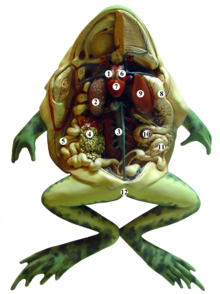
9.  What internal organs did we look for?  We saw the stomach, small intestine, large instestine, liver, gallbladder, and pancreas.  We also saw the heart and lungs, and eventually found the kidneys, bladder, and reproductive organs (testes in males and ovaries in females).

10.  How many chambers did the hearts have?  They had three chambers: two atria and one ventricle.

11.  Could we tell the males and females apart?  Yes, it was very cool.  The females had long squiggly oviducts that ran all the way up the sides of the frogs, which sortof looked like small intestine.  I guessed that perhaps they needed really long oviducts because they need to squirt out a huge number of eggs at one time.  The males didn't have this, and instead had testes, which looked like small white kidneys and were located right near the kidneys (which were dark red).

12.  What do kidneys do?  Kidneys filter the blood and put the waste products into the urine to be peed out.  We clarified that the reason urine doesn't look like blood is because the hemoglobin bound to oxygen, which gives blood its red color, isn't a waste product, and that waste products are colorless or yellow, for the most part.

We also spent time in class going over how to put videos into blog posts.  Hopefully we will all have amazing blogs in our lives, and we vow to share them with each other.  This video is an animation about a frog done by kids in France ages 9-10 with their teacher.

Sunday, December 2, 2012

I am glad i am not a crybaby frog!!!!!!!!!!!!!!!!!!!!!!!!!!!!!!!!!!!!!!!!!!!!!!!!!!!!!!!!!!!!!!!!!!!!!!!


                                        go to
http://www.youtube.com/watch?v=ZLPJIGJWfzA&feature=endscreen&NR=1